
Why High-Income Streamers Are Embracing Ads
The advent of streaming services created an interesting tension in the late 2010s: Specifically, the focus on premium, ad-free services threatened to substantially shift viewer dynamics for ad-supported media, creating a split between “haves” and “have nots.” The marketing dynamics of streaming look very different if ads have essentially become a tax on lower-income households for content.
Fortunately, the rise of FAST services and ad-supported tiers over the last six years has reshaped the landscape again and averted that particular disaster. Nearly half of US subscribers used ad-tiered services last year, and while lower-income households lean on FAST services for budget reasons, higher-income appear to do so out of a desire to reduce subscription fatigue and because they just watch substantially more streaming media.
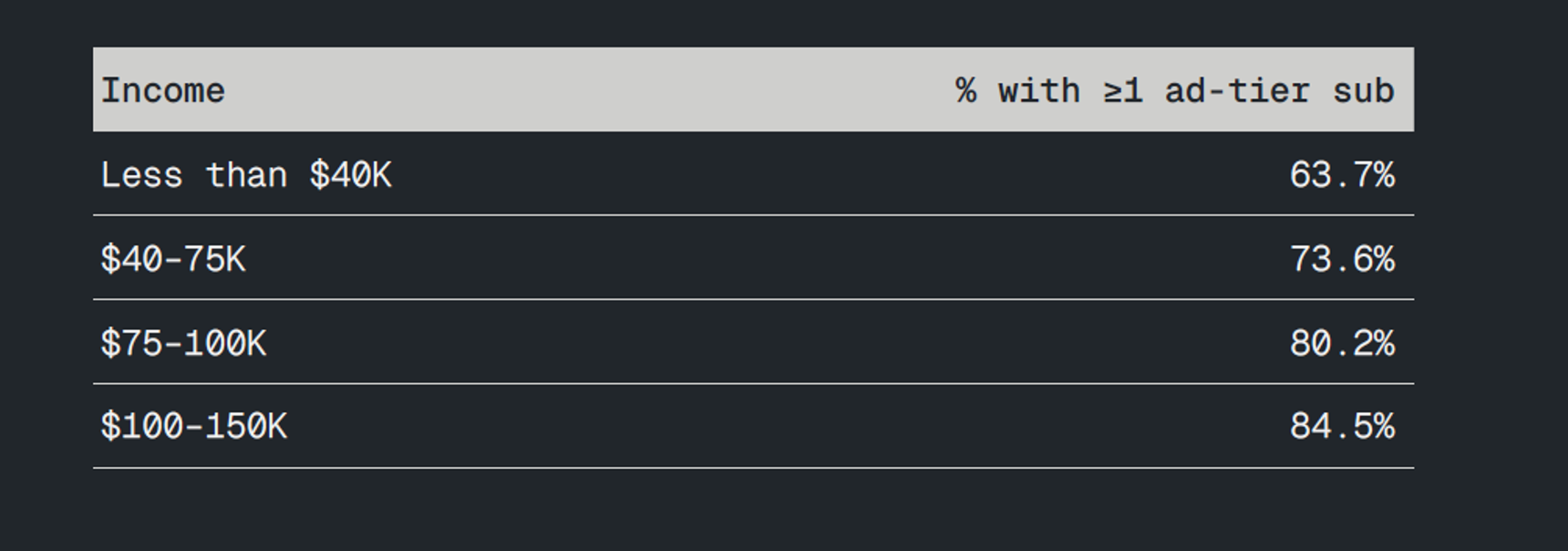
Higher-income households reported nearly double the number of ad-supported subscription services per household than those making less than $40K per year on average, with the share of ad-supported subscribers to key services - most notably Amazon Prime - remaining above 50% even among the wealthiest households. For affluent consumers, FAST and ad-supported services are more about optimizing spend rather than avoiding ads altogether. If there’s a limited amount of content on a given service, they’d rather just pay for it with ads.
FAST services still over-index to Hispanic and black viewership as well as lower-income households, of course. But the reality is more nuanced than that: Advertisers can still capture a large number of higher-income households through FAST services, as those households are both more likely to have more services and subscribe for a particular show or piece of content. It’s not about the platform in that regard, it’s about the content (and always was).

Want to know more about the Olyzon Streaming Pulse study? Contact us to schedule a presentation: sales@olyzon.tv